Figure Size : They Don’t Make Millimeters Like They Used To

More on ‘Figure Size’. This time from January 1966…

A Call to Reason:

OR

They Don’t Make Millimeters Like They Used to

By: Aram Bakshian Jr.

Table Top Talk, January 1966

The past several years have witnessed a mysterious change in the millimeter. Like some elderly matron with a taste for chocolates, the millimeter has lost its youthful figure and gradually expanded!

At least, that is the conclusion one draws when examining some of the model soldiers designated by their manufacturers as “20mm scale”. Some of them stand an inch high, some less than three-quarters of an inch. The effect, when they are viewed side by side, is that of a confrontation between Charles DeGaulle and Mickey Mouse!

Dr. DeGre’s recent proposal that wargamers and collectors band together and declare 20mm scale to equal l/8th of an inch to the foot may have come too late, but it is an excellent one.

Of course there has always been a great deal of variance in miniatures of all types. Anyone who has ever stood a Graham Farish or a Vertunni next to a Metayer or a Mignot knows what I mean. In addition, the same designer may unwittingly slip over the years, or change his “interpretation” of the millimeter.

Compare an early Bussler Revolutionary War Costume piece with his later Battle of Trenton series. In theory they are both “standard 54mm scale!”. In reality one is a short scare crow, the other is an over-stuffed giant! More than one outspoken critic of the magnificent Stadden line has been heard to remark that his remakes look considerably taller and better-fed than his initial models. I also heard one add that they seem to suffer from a strange glandular disorder which results in swollen heads lengthy arms and shrunken feet! This of course, is debatable, and the real issue does not concern any one maker alone.

For despite the myriad of individual preferences and prejudices, all collectors and wargamers can agree on the fact that 1 mm equals 1mm – never any more or less!

The simple table at the end of this article speaks for itself. A figure that is 1” high may be excellently crafted, but it simply is not 20mm!

In a way, while no fraud is intended, there is a great deal of “error” in manufacturers’ designation of scale.

1mm equals . 03937 inch – therefore:

20mm equals . 7874 Inches

30mm equals 1.181 inches

54mm equals 2.125 inches

Figure Size : Small Scale War Game Figures (16mm)

Again on the subject of ‘Figure Size’ I have reread a 1958 article by A.W. Saunders. I this article Mr. Saunders tells us about his new 5/8 inch war game figures. Some quick math tells us that 5/6 inch come to about 15.875mm, so if we round up we arrive at 16mm. I do recall reading about other 16mm figures, but this is the earliest reference I can find. These were not commercial figures, but this is yet another indication that the figure size was chosen for its fit with model kits about the size of the TT railroad scale (TT scale is a model railroad scale; size of which falls in between HO and N scale.  Its actual scale measurement is 1/120, or 0.10 inch = one foot, or one inch = ten feet). Lastly we will also note the size designation is 5/8 rather than some millimeter designation.

Small Scale War Game Figures
By A.W. Saunders

The War Game Digest – December 1958

In recent years many war game players have gone down in scale as far as war games go, Not so many years ago the standard size 54 mm models were locked upon as ideal for the armchair general, but it will be remembered by most that H.G. Wells advocated the use of smaller figures, Not so very long ago came the 30 mm S.A.E. figures, and ideal size for the game and may collectors went over to this scale as one giving much more table room, New with the advent of the excellent Greenwood and Ball figures, produced by Jack Scruby at a reasonable price, many players seem to be going down to 3/4 inch figures which to my mind is a better size for realism? I myself have of recent months gone down to an even smaller figure one 5/8 of an inch tall, As a staunch advocate of the smaller figure for war games, my watchful eye saw not so long ago in the British Home stores some really fine little plastic kits at only 1/ each, roughly about l4 cents The series on sale included Civil War locomotives, prairie wagons, horse drawn fire pumps, coronation coach, stage coach and three types of aeroplanes all in about the TT railroad scale, which by my reckoning makes an infantryman 5/8ths of an inch. By the way I am sure that these kits originated from the Ideal Toy Corp, of the U.S.

I began to ponder on the whys and wherefores of these kits and decided to have a shot at using the excellent material available for moulding and casting, The supply wagons of course were cheap enough to buy and use as bought and for artillery wheels and cavalry horses the fire pump kit supplied three horses per kit and two wheels of just the right size for cannon and limbers. The coronation coach had the riders I wanted and a mould was soon made of these and the fire pump horses. Both came out of the mould very well and very soon two cavalry squadrons of twenty troopers each were made aid painted. I found the wheels almost impossible to cast so went out and bought up the entire stock if fire pumps in the stores, finishing up eventually something like 30 fire pumps which gave me a total of 60 wheels and 90 horses, then I came to the great snag, the infantrymen.

This little figure I made myself, but try as I might, I could not get out very good castings, I sent them to Jack Scruby for his inspection and back came the suggestion that solved the problem, if I never did thank you for this Jack, thanks a lot. The solution was simple, make a thicker base and fill from this base.

With the infantryman solved, I soon amassed a sizeable number in all, to date, I have made and painted 240 infantrymen, 40 cavalry and two cannon with 10 cannoneers Of course as homemade figures, the models are not in great detail, in fact this isn’t needed in such a small scale. Look at them singly and one doesn’t think much of them, but put them out enmasse on the table with colours flying and the effect of the whole is quite satisfying, almost as if one were in Professor Lowes’ balloon hovering over the battle field. The extra room gained for maneuvers makes the whole lot of hard work I have put in worth it and already I have mad moulds and cast some modern figures for a game of this period, (1939-45), In this case the infantryman is in exact scale with the Authenticast tanks.

I am finding too, that with this very small scale, I can become ambitious as far as the Civil war goes bring into the game much that would not be possible on my ten by five table with 30 mm figures. It is well known that the Civil War, as much if not more than most wars, brought into play the whole panoply of the art of war. This terrible conflict saw terrific land fighting in field warfare, sieges and far flung cavalry raids. A blockade was carried out by the north and some very fierce naval warfare took place on the rivers, submarines of great ingenuity were used, manned by crews of great courage. Partisan activity was rife. In fact their isn’t much in the art of war that cannot-be tried out on the war game table in period, no wonder the Civil War is such a favorite with so many war gamers.

John Greenwood : Tabletop General

While browsing for information concerning ‘Figure Size’ I came upon this piece on John Greenwood. It is one I enjoyed reading many years ago, and though it might be a good time to share this with you. Originally presented in: The War Game Digest – Winter 1962

John Greenwood

Born 1893 at Lowestoft, Suffolk. Lived at Scarborough from the age of l month until 1909, in which year I moved to Newcastle to serve an apprenticeship. During this early period of my life the model soldier bug bit me, as during the South African War of 1899-1902 the daily illustrated papers were full of war pictures and my father explained much of the material to; so in 1899, to the question, “What would you like for Christmas?” the answer was invariably, “Soldiers”, and it was a great Christmas: British-made Cavalry, Infantry, Mule Battery, and German-made Field Artillery. This interest was maintained by the Sum er Camps on the local race-course of Volunteers, and later, Territorials, with field days and sham fights. When at Newcastle, there was always something of military interest to be seen or read– troops on Church Parade, books on Army life,and in the papers there were reports on the various Balkan Wars and so forth.

Then, in 1914 out of a summer sky came the Great War. On the fourth of September I went to Manchester and joined the 2/6th Battalion, Manchester Regiment. This was a Territorial Battalion, but what a wonderful lot of fellows to be with. In May 1915 I sailed with 49 other volunteers to replace sick, etc. as the lst Battalion sailed from garrison duty in Egypt to Gallipolli. We arrived at Cape Helles, Gallipoli, in June and I found the lst Battalion fellows as good to get along with as the 2nd Battalion. 1915 Gallipoli; 1916 Sinai Desert Campaign; 1917-18-19 France and Flanders: that was the “Cook’s Tour” and I think I had my money’s worth. For people interested in this sort of thing, the pay was 1/- (about 15 cents) a day when I joined and also for the next three years. I returned to civilian life in 1919 and up to 1936 had various jobs as a salesman, none of which produced a fortune.

In 1936 I was staying with the late Mrs. Ball and her daughter Kathleen, and as some of you may know, began trying to make realistic-looking chessmen, and this started me off on model-making. The whole thing was an “earn while you learn” business for Kathleen and myself. We both had great patience and the ambition to reach the highest standard we were capable of. Gradually the thing developed and we employed girls and taught them to paint. Then came the second Great War and we switched over to making training tables for the Army and the Home Guard. This kept us going, and after the war business came along; at one of the British Society’s meetings the late Otto Gottstein approached us on the subject of figures for dioramas. A team was formed under his direction of Denny C. Stokes to make the dioramas, and Greenwood and Ball to make the figures. Dioramas were made for the R.U.S.I., Arromanches Museum, and the History of the Jewish Nation.

In the last few years Stokes and I have worked together on a wide variety of dioramas, both military and commercial. At present I am working on figures for a series of dioramas he is making of the war—time activities of the Royal Army Medical Corps. Kathleen still carries on with the trade sign of Greenwood and Ball 54 mm. figures and I am concentrating on 1 inch and 3/4 inch figures for collectors. I have also made a few complete dioramas for private collectors, two for the West Point Museum and a third one on the way to competition.

About four years ago, when we were in Broseley, Bill and Helen Imrie called to see us, and we had a very enjoyable day with those two very charming people. Bill and I still correspond and do the odd spot of trade with each other. When the War Game Digest came out, Jack Scruby and I made contact and this started a grand friendship, although we never met. The War Game Digest is something to look forward to, and a most interesting development has been the Scruby and Greenwood War Game figures. I get a real kick out of the narratives of Table Top battles reporting “G&B 3/4 figures were used in this battle”.

Of course, I don’t think it’s possible to make model soldiers for others people and not a want; a few yourself; that leads up to, “What do I collect?” Slowly and laboriously, owing to the time factor, I have during the last few years produced some small 3/4 inch forces, not big enough in numbers to be called armies. They are compact forces of about 200 each; British and German in Tin Hat? with some  armoured Cars, Tanks and Lorries; World War l British in Peak Gaps and Slouch Hats; British in full dress 1900; and smaller French forces of the same period.

Building up the country for War Games has been as enjoyable as pre—fishing preparations, and has resulted in a nice collection of Faller buildings with a good but limited range of plastic trees and some home—made ones which look fairly good but are not well known types! Next effort will be the countryside which must be fairly changeable, and this is a very interesting problem to solve. With luck I should have a solo War Game going by next winter.

That is the life—story of old man Greenwood; you may not enjoy reading it, but I’ve enjoyed living it– most of it anyway.

Holger Eriksson

Another of our lost articles  for your reading pleasure:
From 1968 and written by John Scruby…

HOLGER ERIKSSON
By John Scruby

I visited Holger Eriksson in the later part of October, 1968 at his home in Karlstad, Sweden. He lives camouflaged in a quiet neighborhood a few kilometers from the center of town. I was immediately welcomed into the house by Holger and my stomach warmed with coffee and cakes by his wife Greta. I could speak little Swedish and Holger could speak little English, but through many different actions, hand and arm signals, drawing pictures, or Holger just showing me certain figures, we communicated well.

In Holger’s house there are three floors, and he commands two of these for his work. The cellar is used for molding, casting, stocking and displaying his figures, while on the top floor he has a library, where his original figures are designed. Holger employs the middle floor of his house to retreat from his work and to be with his wife.

Holger began with soldiers as most the other collectors and designers I have met, as a boy with a few figures. His first toy soldiers were Britains. In his childhood he lived in a dream world with visions of toy soldiers everywhere. Since he had only a few at this time, he made illustrations showing Swedish troops in different positions.

In 1925 he began making his own figures, but they were not of lead but hand carved of wood. He showed me some Cowboys and Indians (54mm) which he had carved around 1926 and then a stand of five German horse figures (88mm) made in 1930. The transition from the cowboys to the horse figures showed me that during that time he was getting much more serious about his figures.

In 1934 he made his first 54mm lead figure and this was Holgar’s first big step, which lead to the position he now holds in this hobby. In 1944 he made his first 40mm figures; in 1945 his first 20mm scale models, and in 1949 his first 30mm.

For collectors he was probably most widely known for his 54mm Authenticast figures. He made 500 originals for Authenticast from 1944 to 1951. These originals were sent to Ireland, where they were molded, cast and painted and distributed throughout the world under the Authenticast brand.

Authenticast was the first company in the world to use rubber molds for the production of these figures. They used round rubber discs, using centrifugal force to get the detail that the Eriksson figures deserve.

Between 1951 and 1960 he designed 30mm originals for the South African Engineers (SAE), which many wargamers are familiar with. This company started in Ireland originally, but ran into some difficulties and moved to South Africa and I understood from Holger that they are no longer in business.

Holgar told me that today my father is the only one that is casting the HE figures, as all his previous contracts have long ago run out, or gone out of business. The 20mm Modern figures cast by my Dad are no longer even cast by him. I can remember when I was a little kid that these used to be put out in painted, boxed sets under the Comet and Authenticast brand.

I was especially interested to see how Holger made his originals, for I can remember when my father was making molds of the HE horses, how he mentioned how perfectly engineered they were – the “parting line” was so precise and exact.

As you can see by the accompanying photographs his originals are modeled in clay in which one side of the potential mold is made. On this side he sculpts half of the figure that he wants. On another block of clay he forms the other half of the figure. He uses only three small tools and the rest is done with the skill and talent of his hand and mind.

You can plainly see in the photographs that the horse has has several leg positions. Holgar will select the one he likes best and “erase” the others. A plaster mold is made from these clay blocks, and from this a rubber mold is made to complete the project.

Today, Holger sells his figures through his own catalogue and direct from his own house (Address: Sommarrovagen 8, S-65230 Karlstad, Sweden). He casts not only 30mm figures, but beautiful 40mm and 54mm figures that are not from the Authenticast line. His trademark, HE is world renowned. I was surprised to learn that he only receives a few orders by mail a week and that most people who do buy figures from him come and visit him personally and buy from his stock. He has also sold many painted figures to Swedish military museums and to museums all over the world.

I would judge that Holger is in his mid-sixties, but with him age is of no importance. Despite our language barriers, in the two days that I spent with him, I found him to be a warm and delightful person. The making of military miniatures now takes up most of his time. Holger is an engineer by profession. I rather doubt that in my travels I will meet anyone more interesting in this hobby. After having heard of Holgar Eriksson all my life, I can truthfully say that he lived up to all my expectations.

In the month or more that I spent in Copenhagen, I visited most of the military museums in the area. At the Royal Palace I was somewhat amused by the red-coated Grenadier Guards because I am accustomed to thinking of such troops as all of one size as military miniatures! It seemed rather strange to see these men in their huge bearskins being of all sizes – some being gigantic, some being smaller and thin!

These Palace Guards march a certain path in Copenhagen before they arrive at the Kings Palace at 12 noon. There they go through the normal procedures of the changing of the guard with tourists snapping pictures. But for those who do not rise before noon and cannot make this event, I have a suggestion and I feel any wargamer or collector visiting here would enjoy it more. Leave the pub early, about 11:30 at night, and wander over to the palace. There before your eyes you can have a private showing of the change of the guards! It is a much simpler version with no bands playing, but you can see exactly what takes place and see a more personal side to these young men who are wearing the large grenadier hats. For me it was much more rewarding.

My stay in Copenhagen lasted until Christmas, and it is getting extremely cold as I write this. My plans are for heading south to sunny Spain, and there is little doubt but that I shall find others in the military miniature field in Europe that will be well worth interviewing.
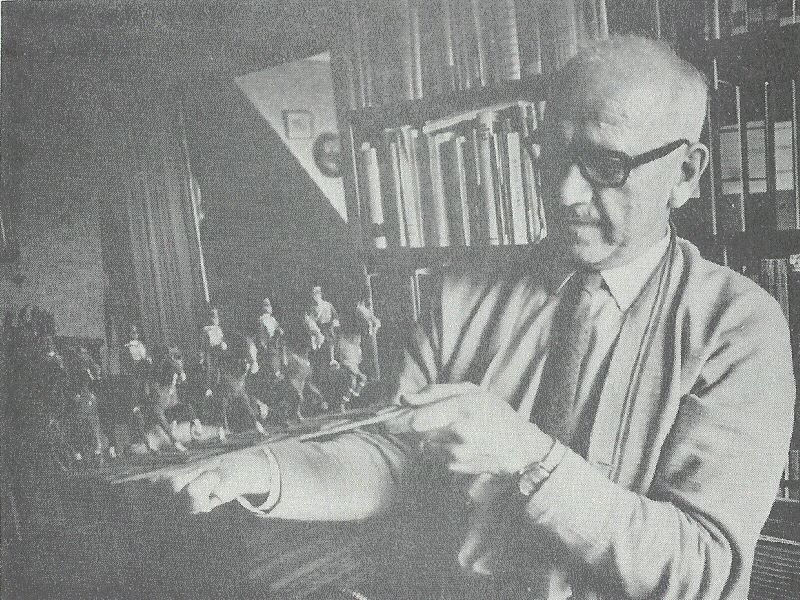
Eriksson with early hand carved wooden miniatures
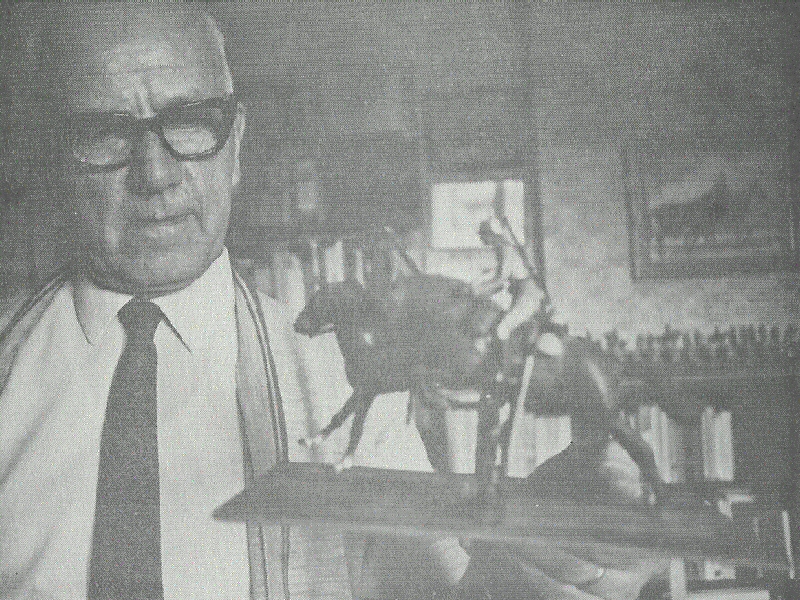
Eriksson with early hand carved wooden miniatures
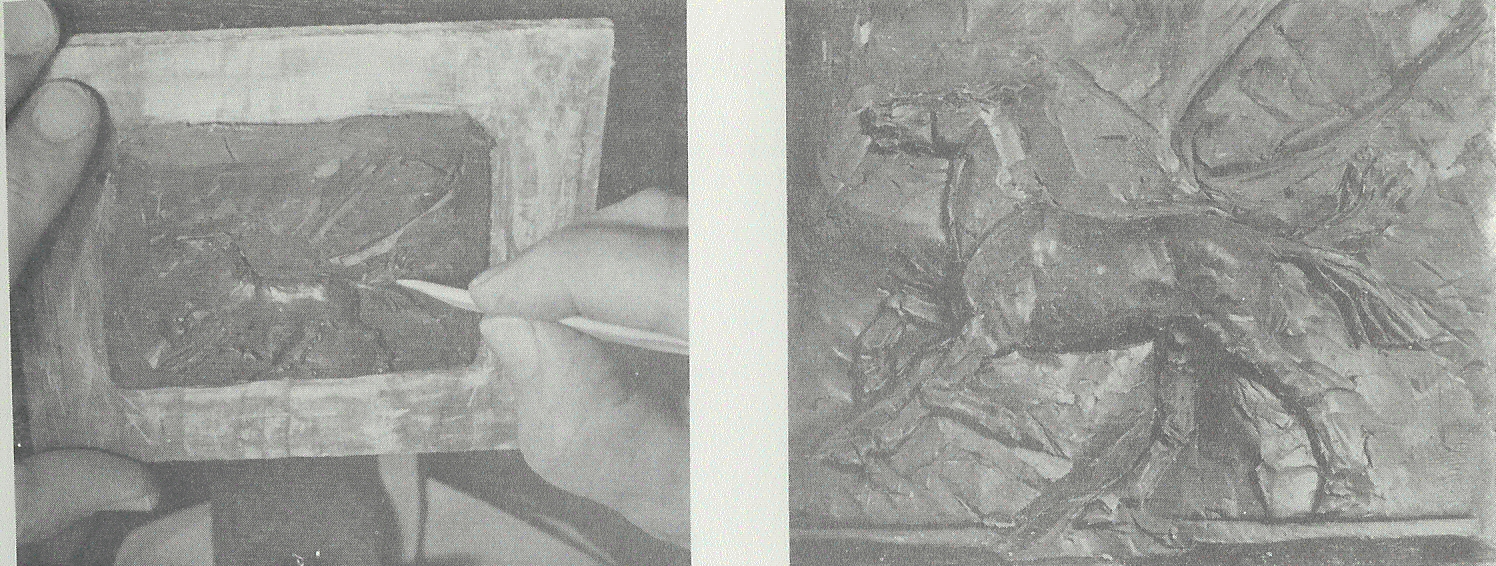
Eriksson with early hand carved wooden miniatures

Eriksson with early hand carved wooden miniatures

An Eriksson original in the making
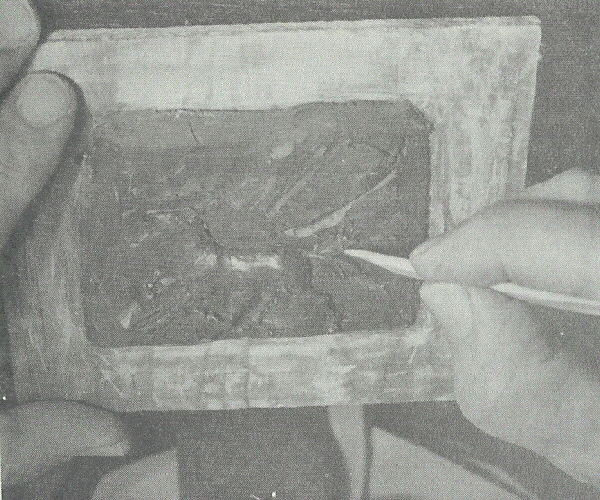
An Eriksson original in the making
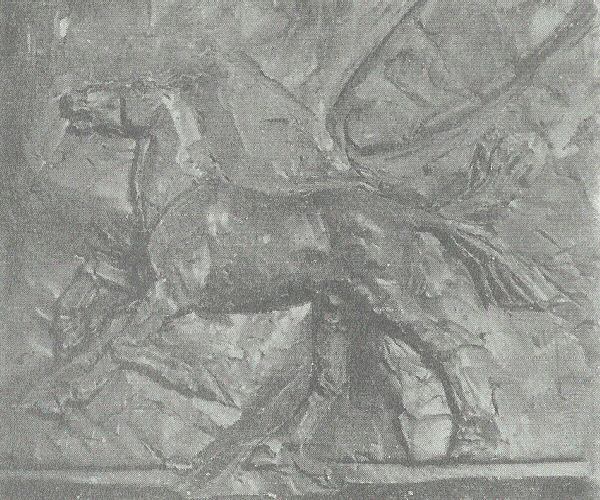
An Eriksson original in the making
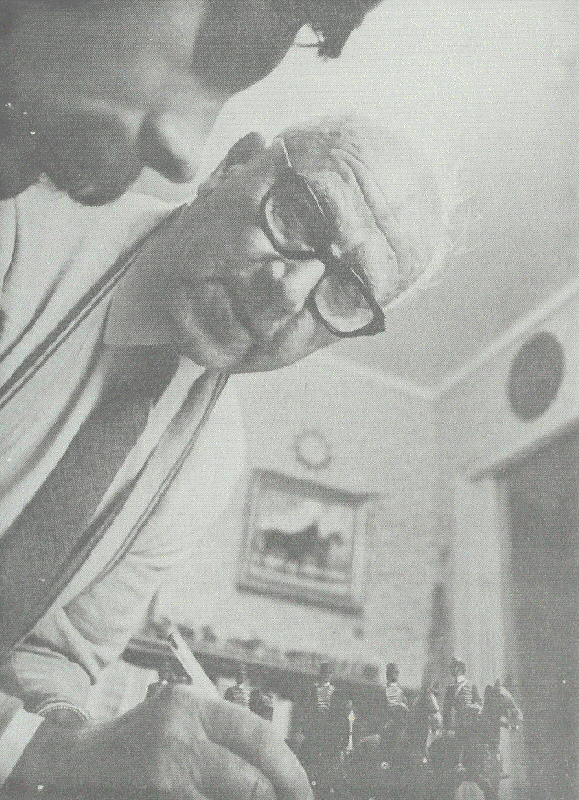
An Eriksson original in the making

An Eriksson original in the making

An Eriksson original in the making

In the Eriksson library
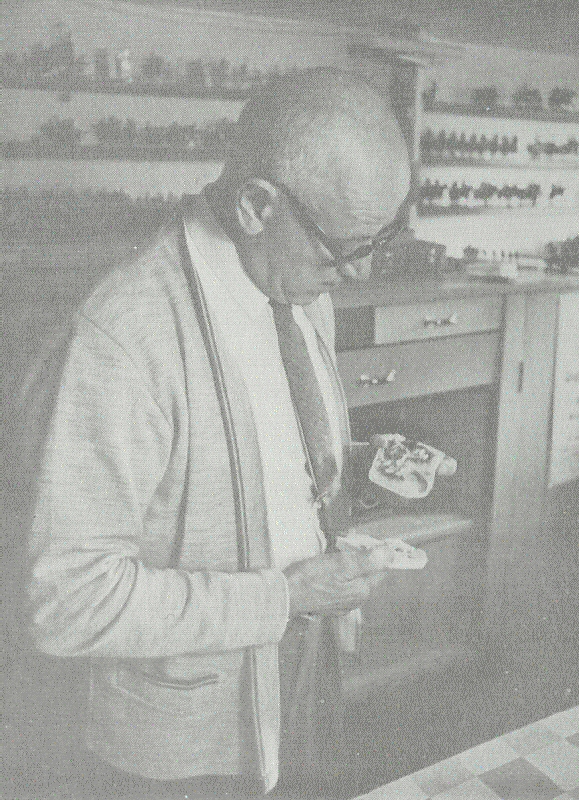
In the Eriksson library

Eriksson in his basement casting room

Eriksson in his basement casting room

Be sure to visit The Tinfigure Company for your Eriksson figure needs
Dodd vs. La Duc

May has been a busy month, my backlog of figures to photograph continues to grow. As soon as I can clear the photo area I’ll grab the camera and start shooting pictures…

In the little bit of spare time I’ve been able to find I’ve been revisiting my Napoleonic Skirmish Game project. As you may know from previous posts my Napoleonic skirmish game uses our Scruby 45mm Napoleonic Skirmish figures and for rules I’ve been using my Napoleonic TSATF variant – The Sword and the Eagle. While I really like TSATF, I’ve never been really happy with my Napoleonic version. I’ve tried several other rules sets including Sharp Practice (Too Fat Lardies), but until recently I have not found a set I really like. Some number of months ago I decided to try out one more set of rules: Song of Drums and Shakos (Ganesha Games). So far I’m really liking this game system (In coming weeks I’ll be writing more about our exploits using various rules sets from Ganesha Games)…

Song of Drums and Shakos is a fast playing Napoleonic skirmish games based on the popular Song of Blades and Heroes system. One of the really nice things about this system is that one can play with as few as 5 or 6 figures per player; a points system is used to balance player forces. The game mechanics are far from complex. Each figure has a quality rating and players role for activation for each figure. Depending upon activation roll results figures can perform up to three actions per turn.

The game design is such that it can be used with nearly any figure scale you desire. The rules include measurements for 15mm to 40mm (all measuring is done using measurement sticks – Short, Medium and Long). When playing with 15mm figures one can play on a surface as small as 2 feet by 2 feet (with 28mm figures – 3 feet by 3 feet). For my 45mm figures I’ve adjusted measurements and play in a 4 foot by 6 foot space. When I first wrote/posted this I did not have my notes with me; thus didn’t get ‘it’ right. My adjusted measurements for 45mm to 54mm figures are as follows: Short 115mm, Medium 180mm and Long 270mm. The rules actually provide measurements for 40mm figures. However, most modern 40mm sculpts seem to fit into the same space as 28mm figures, so I recommend using the 25/28mm measurements as presented in the rules. If your 40mm figures have a larger footprint using the 40mm measurements or even my alternate 45/54mm measurements will work just fine. I’ll stick with my recommend playing space of 4 feet square for 40mm figures, unless you are using my alternate distance measurements; in which case I recommend my 4 foot by 6 foot space.

Now that I have a nice , simple set of rules I expect that Lance Corporal Dodd and Carabinier Sergeant La Duc will see much more table top action! Perhaps when I find time to remold, cast and paint some more of the Scruby 54mm Napoleonic miniatures I’ll bring  Sergeant Vladamir of the 37th Russian Jagers out of retirement (I did finally manage to locate the Sergeant Vladamir figure as well as four of his fellow Jagers).

Song of Drums and Shakos is expanded by More Drums and Shakos; which includes additional rules, special rules, weapons, four (4) scenarios as well as army lists for most Nations involved in the Napoleonic wars…

I’ll close out with a N-gauge teaser…

Look for NEW N-gauge Tricorne Era figures in the very near future -Last night I cast patterns for Officers (foot and mounted) as well as the first of the New Highlanders…