Toe-to-Toe Nu’klr Combat with the Rooskies

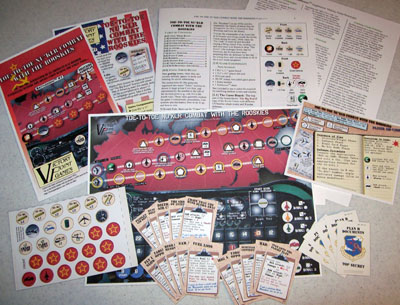
The other night I had a chance sit down and try out this, fun, new game from Victory Point Games

Toe-to-Toe Nu'klr Combat with the Rooskies

Ok, so your first question is: “What is this Toe-to-Toe Nu’klr Combat with the Rooskies business all about?

Well, I’m gonna cheat here and borrow from the VPG website;Toe-to-Toe Nu’klr Combat with the Rooskies is a fast-playing solitaire game. You decide the payload, pick your targets and must then challenge the Soviet Union’s defenses.”

This simple statement really sums things up nicely. Sure there is more to it than that, but this description was enough to make me want to try this one – in short the game fully lives up to this description. It is a fast-playing game. Pick a target, determine the payload and go for it! easy as pie (really).

The game uses a card & chit (marker) system. Markers are placed face down in each space along your selected flight path. Entry into a space reveals the marker, (a SAM site, MIG aircraft, increased awareness of your ingress, or a random event). Encounters are frequent, and must be dealt with…

Choices, and you do have choices to make, increase altitude to reduce the chance of a SAM hit? Or perhaps go in under the radar? Watch your fule consumption – you do want to make it home don’t you? Perhaps a target of opportunity (a newly discovered missile silo) will appear? Do you hit it or push on to your primary and secondary objectives? Dont forget to use flares (handy when dealing with MIGs) and chaff (if dealing with SAMs)…

All this and more awaits you in Toe-to-Toe Nu’klr Combat with the Rooskies. Wait, we forgot about the fat playng part – an average game can be completed in under 15minutes (including setup) and with a campaign game length of 4 missions you wil have an enjoyable hour!

Yee-Haw!

Victory Point Games (my new favorite board game publisher) hits another home run!
 

Designing Rules with Liam…

As I sit-down to write this post, I have no clear direction in mind. I’ve been thinking about the process Liam and I are using to write a set of rules for his games and thought, that maybe others might find the topic of interest…

First, some background. We wanted to create a simple set of rules that Liam could use to play some games with his friends, but we also wanted something that we could expand easily. Our initial target is a Fantasy / Medieval war game. Nothing fancy, just a basic or introductory game. Version 1 of the rules was aimed at 54mm plastic knights. Version 1 was outdated before the first page dropped from the printer!

I should start with sharing some of our basic design parameters. First all info required to play (charts, tables and the like) needs to fit on two sides of an 8 1/2″ x 11″ sheet of paper.  We decided to leave out things like: Formations, Fatigue and Morale. They will be added into the more detailed game, but we felt that for introductory purposes these would just bog things down. We also decided to leave out any complicated command structures (I’m letting turn sequence handle that for now). Keeping things simple allows us to focus on rules for: Turn Sequence, Movement, Melee and Ranged Combat.

Melee combat is simple enough – each player rolls a d6, the high roller score a hit. In version 1, a Hit was the same as a Kill. After some play-testing, we decided to allow the Player to roll for a Save. Liam had wanted to add Hit Points, but I talked him out of that, as I wanted little or no bookkeeping in the game.

Ranged combat is also resolved by the roll of a d6. Make your point and score a Hit – again, we allow player to roll for a Save.

Note: Types or armour or weapons are not accounted for in this game. We will add rules for weapons and armour types, but are keeping it super simple for now.

Artillery is similar to normal (personal weapon) range combat, but I wanted to use some of the ideas from the original Chainmail. For cannon fire we use a range/bounce stick to determine where the projectile hits (roll a d6 for each figure hit). For catapults we use an impact template. roll a d6 for each figure in the impact zone. As always any Hit figures roll for Save.

Movement is, well Movement. We keep it simple. All Foot troops have same movement. All Cavalry has same movement. All Artillery has same (limited) movement. Terrain restrictions are minimal (for now).

Turn Sequence is also fairly simple. Roll for initiative (high roll chooses first or second on the turn). First player for the turn performs any Ranged Combat, Movement and Melee (in that order) for his troops. Player two repeats same.

The above doesn’t cover all of our rules, but it does cover most of the basics. We’ve looked at a number of different rules mechanisms, but keep coming back to our basic rules as being the simplest, fastest and cleanest. There is plenty more to add (and we can do so without making the game too clunky), so our current 1.3 version won’t be the last by any means.

For those curious about our armies; we are using a mix of figures. Many are Mage Knight figures. Some are Hero Clix (but treated as regular warrior rather than super heroes). There are also some number of miscellaneous figures (no idea where they came from). Rounding things out are 30mm Scruby and 25mm Bloodaxe figures. We still have a set of 54mm knights, mostly plastic. We don’t mix these with the smaller figures – we just play a different game (same rules) with those.

Liam and I will be sure to post some pictures from our next battle. We may even post a copy of our rules – but not before some more playtesting!

Painting Habit Weeks Two & Three

So far, so good for making a habit of painting…

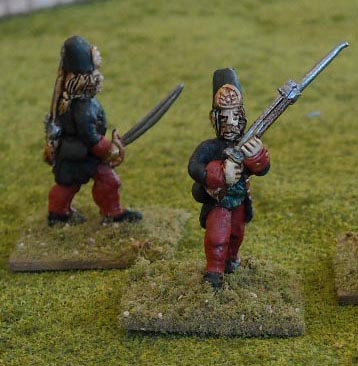
Well, week two was a bit touch and go. I had started a batch of ten 25mm Russian Pandour (Bloodaxe Miniatures), but I tried using a black undercoat and I was very unhappy with the results I was getting, so about mid-week I stopped painting that batch and started prepping a new batch (of 12) for week three. This time I went back to a white undercoat…

I’ve never really had good luck with a black undercoat, but with a lot of black to be used for the figure, I thought I’d give it another try – it turned out to be a bad idea. I just was not happy with the results. Good news is that I decided to finish the figures in this batch and just mix them in with the rest.

OK, so now back to week three. This second batch of Pandour were undercoated white and they were much easier to paint. After the white undercoat was dry I started with a series of washes – red, black, sepia, brown and green. The idea was to create a set of lines, much like a coloring book. After the series of washes were applied I went back and added the proper paint colors – coloring inside the lines. After the colors were applied it was back to washes – filling in the gaps, or darkening the lines…

Now, please remember I’m not now and never have been a really good painter, but for the most part I am happy with the figures and they (at least to me) look just fine on the game table.

This unit of Pandour need 14 more figures and it will be complete (36 figures). Eleven of these 14 are on the table for painting this week. The command figures were not quite done, so they will be painted next week. At some point I’ll add another 12 figures to the unit.

While I sort of missed the mark for Week Two, I made up the lost time in Week Three – total output for Weeks Two & Three = 22 figures…

I’ve started a photo album to show the progress of my painting projects. To view more photos from my 2009 painting adventure visit my Painting Habit – 2009 photo album: http://picasaweb.google.com/historifigs/PaintingHabit2009#

I’m still sorting out how best to take pictures with my replacement camera, so it may be a few more days before we can post some picturs of the new Resistant Roosters Winter Finns (Company HQ and Mortar Platoon)…

Make Painting a Habit

The subject of painting miniatures has been on my mind of late. Helped along no doubt by recent reading; I read a lot, but I’m always behind on magazine/periodicals. As such it wasn’t until last week that I finally took the opportunity to read White Dwarf #346 (November 2008). For today’s topic I have a specific article in mine: Jervis Johnson writes a regular column entitled Standard Bearer. The subject of the column appearing in WD 346 is Making Painting a Habit.

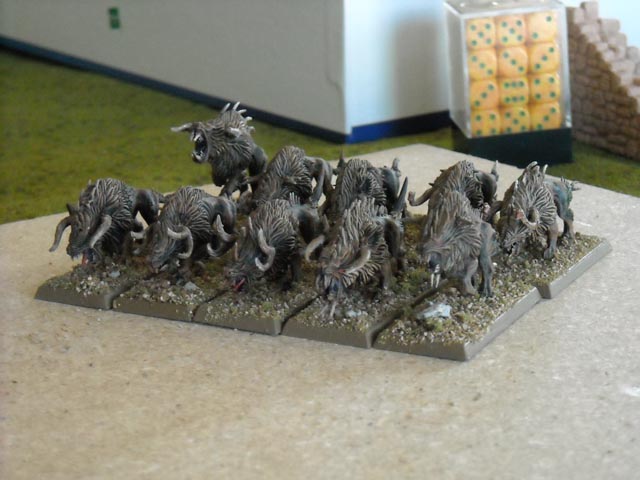
When it comes to painting, I’m slower than molasses in January. Add to that the fact that I’m no great artist, and well you can guess that my painting output is, well at times non-existent. Sometimes I get into a painting frenzy, and other times a painting funk – not really much of a middle ground for me – I either paint or I don’t. For example, in late summer and early fall (of 2008) I was on a painting rampage (well at least by my standards). I was painting nearly everyday. I’d even get up early to paint before going to work. Not sure how many figures I painted, but I’m sure the quantity outpaced my previous best. I was working on multiple projects in multiple scales (10mm, 15mm, 25mm & larger) and multiple periods (WWI, WWII, Science Fiction and Fantasy). I even painted several complete units! And then, come late fall/early winter I just stopped painting, leaving multiple projects on the table unfinished.

I’ve always wanted to get into a painting routine, I just never seem to be able to make it happen. As such when I came upon Jervis Johnson’s column (in WD 346) I was more than mildly interested in the topic. The idea of making a habit of painting really struck a chord. But, how does on make a habit of painting? Getting ones self organized is part of the solution. Now, those of you who know me will know that I’m either quite organized or not organized at all – sometimes my organizational ability falls into the middle ground, but typically I’m at one end or the other of the spectrum. Right now my painting area is split between the game room and the basement. OK, I need to consolidate the painting stations (just as soon as I have a few spare hours I’ll get right on that). While not quite there yet, I do have everything I need for painting in the game room – so I’ll check this off my list (I’m now organized, well mostly at least). Next I suppose that one should have a clear painting plan in mind. That makes perfect sense, if I don’t know what I want to paint I either paint nothing or as I typically do whatever strikes me as interesting at the moment I feel like painting. Deciding what to paint can’t be that hard, can it? Lucky for me it isn’t too hard (right now). I have two projects I want to complete this year. Fist I want to complete my WWII armies (for Flames of War). I’m working on two right now: Early War French and Mid/Late War Americans (this is one of the projects I was working on in late summer of last year). My other project (also spurred on my WD 346) is to round out my Warhammer Chaos (Warriors) army. I like the combination, it gives me two very different projects to focus on – allowing for a nice break when I get tried (or bored) with painting one type of figure.

OK, so now I have an organized workspace and I have a plan. What next? I still need to make a habit of painting. Here is the final key from the Jervis Johnson column: Let’s face it, everyone can spare 2-3 hours a week to paint miniatures. Brilliant! This hits the nail on the head. Two to three hours a week; lets see if we assume the full 3 hours and divide by 7 days in a week we arrive at a mere 25.7 minutes a day – OK, round to 25 minutes. Now, that doesn’t seem to hard – drop the total hours to two and we are sitting at about 17 minutes per day. Hmm, this might not be too bad. So, now we need to set another goal. How many figures do we want to paint each week? Again borrowing form the WD article I picked 5 figures per week (at least as a starting point and assuming 28mm figures). So, now I have: An organized workspace, a plan and a goal…

I started to form my new painting habit on 1 February 2009 and can report that the 5 figures from week one are now complete (OK, they need a sealer coat, but I’ll do that when I finish the next 5). And now for a picture of painting output from week one:

I’ll post pictures each week; the pictures may not always be pretty, but they will show how my habit proceeds through the remainder of the year.

If you are not in the habit of painting (your miniatures) perhaps now is a good time to pick up a new habit. Come on, you know you need another battalion of …

NIEUCHESS

Recently I decided it was time to introduce Liam (age 7) to commercial war games. Sure, we have played a few home designed miniature rules systems and some of the more kiddie type war-like games, but we’ve never played a commercially published game…

I wanted a simple game – no complicated rules mechanisms or the like. I started by pulling out some of the older Avalon Hill games I have in my collection, but all were more than I wanted for a beginners game. Then I remembered Nieuchess

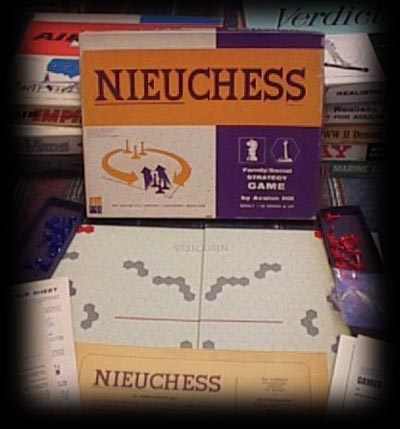
NIEUCHESS: AN ADULT STRATEGY GAME – published by Avalon Hill, 1961

A quick review of the rules and I knew that this was the game to start with, a traditional Avalon Hill game, hexes and a combat results table revolving around a 3:1 CRT table. The game board is 25 x 36 hexes and each player commands 20 pawns (pieces). Movement is simple as pie – each pawn can move 5 spaces, we have invasions and a red line (the line is like a railroad, unlimited movement along the line). Combat results are pretty straight forward too – figure odds, role die and apply result (not complicated, and a quick review of the CRT will inform when and how to attack – Liam figured out very quickly). The game ultimately boils down to a battle of attrition – what war game isn’t about attrition at some level.

All in all, a really good introductory game – even after 47 years…