Another year is almost in the books and today is Christmas Day…
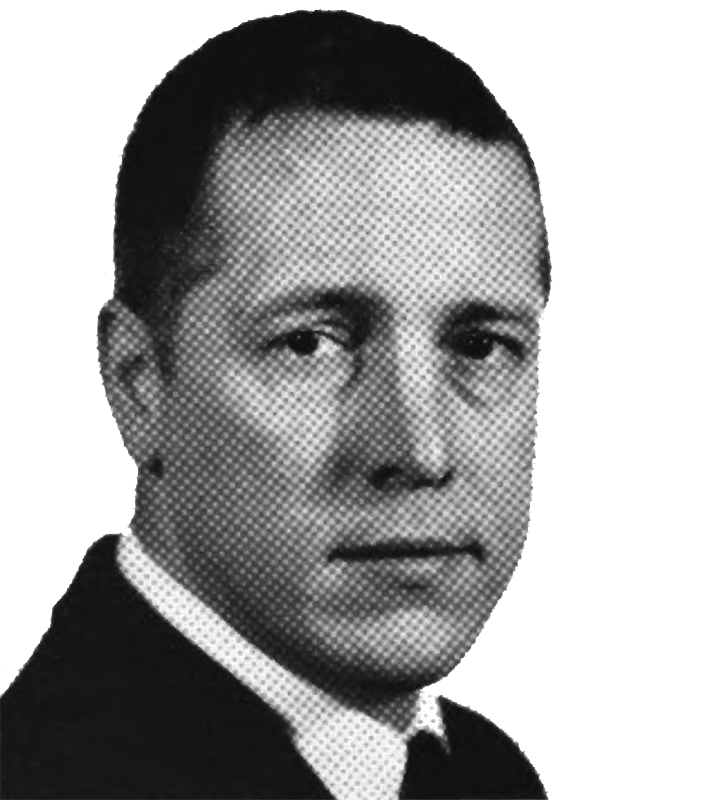
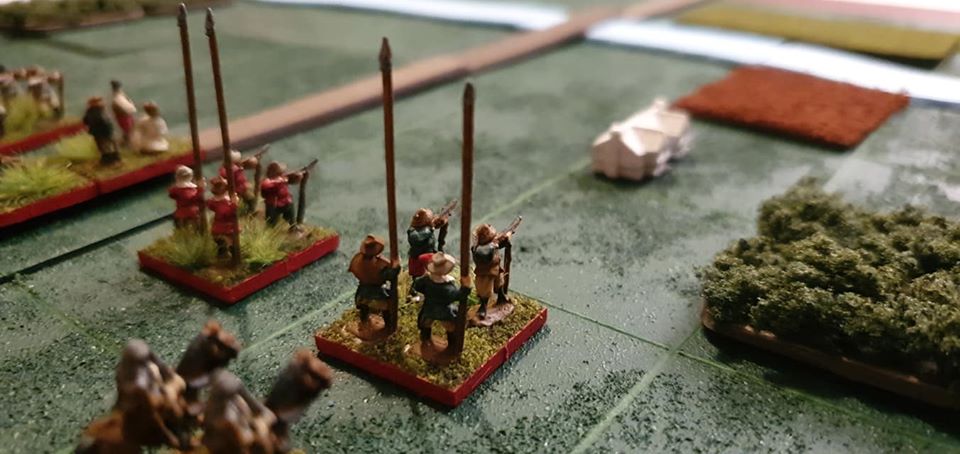
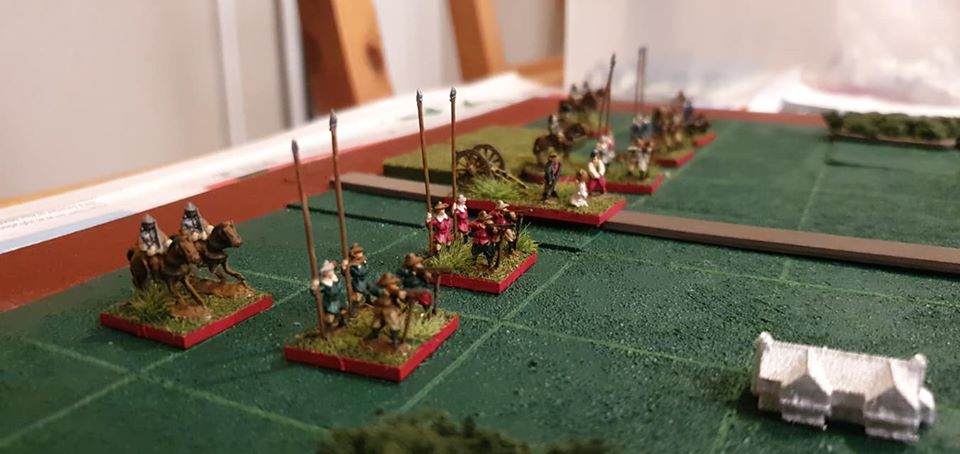
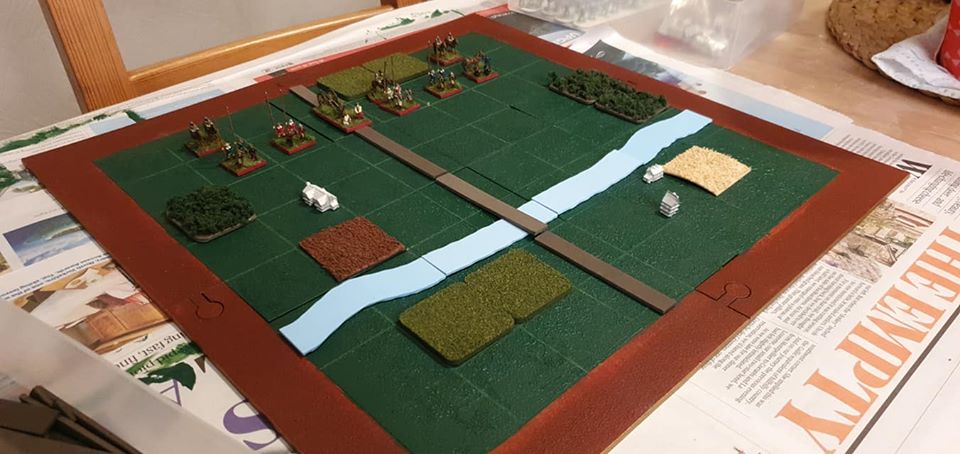
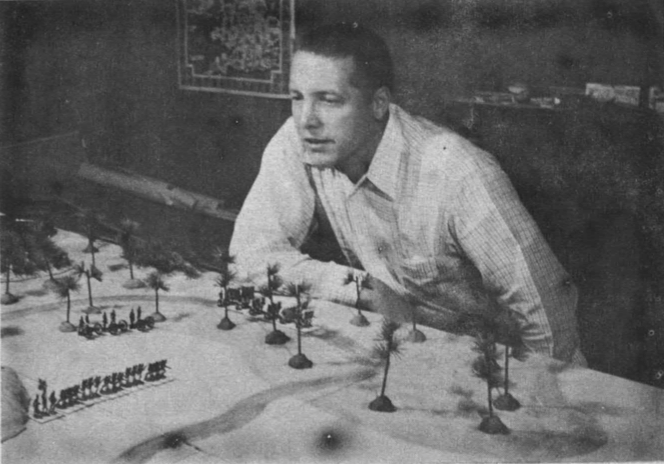
This isn’t a Christmas story, but it is a story (article) written by a man born in New York City on this day in 1924; the man who is, perhaps my biggest war game hero: Joseph Morschauser III – who, more than any other war game author who has kept me going with my war gaming hobby. His book, ‘How to Play War Games in Miniature’, has been my go to book for war gaming inspiration since the day I discovered it in a local book shop in the 1970s…
Today, our (Joseph Morschauer Day) gift to you is an article written by Joe for ARMOR magazine: March-April 1960.
Blowtorch Battalion
By JOSEPH MORSCHAUSER, III
THE atomic destruction of two Japanese cities ended the second World War with such dramatic force that the bitter battle immediately preceding it was almost completely obscured. Larter general histories and film documentaries barely mention Okinawa and the thousands who died there. Historians have fallen into the habit of jumping from the fight for Iwo Jima directly to the dropping of the first atomic bomb, ignoring the fact that all the deadly tricks ever developed by the Japanese reached their perfection in that last great land battle of the war.
As the struggle in the Pacific moved ever closer to the home islands, the Japanese grew more and more fanatical. On each new island they dug deeper and deeper so that by 1945 it had become almost impossible to root them out with shells and bombs. In desperation, American commanders improvised weapons to do the job. This is the story of one of the most effective of those improvisations.
On April 19, 1945 the National Advisory Committee for Aeronautics (NACA) revealed it had been experimenting with jet propelled planes which might fly up to 2,000 mph; Manager Joe Cronin of the Boston Red Sox fractured his right leg in a game with the New York Yankees in the Stadium; Some 50,000 textile workers got a 50-55 cent per hour wage boost and the U. S. Census Bureau said that 30 percent of all servicemen and women of voting age cast absentee military ballots. An estimated 183,000 of the remaining 70 percent were too busy. They were struggling with a determined and fanatical Japanese army on Okinawa.
On 19 April, 1945, a Japanese private of Lieutenant General Mitsuru Ushijima’s 32d Army crouched in a cave south of Machinato on the west coast of the island. Several hundred yards north of his position a company of the 106th Infantry, 27th Division was advancing. Getting a figure in his sights the Japanese pri\·ate opened fire. In a few moments the Americans were pinned to the ground and artillery fire began to rake their positions. The Gls could not move and could not hurt the Japanese in their deep, well prepared positions. And in a few moments more the cry crackled out over American radios, “Hey, Zippo, come on!”
Shortly several M4 Sherman tanks ground forward, their dull green hulls shaking off small arms and artillery fire. The Japanese stopped one by smashing its drive sprocket with a 47mm anti-tank slug but the others avoided the gun’s fire and crawled up to the face of the escarpment. The tanks sprayed cave entrances with 30 caliber slugs. But the Japanese were no longer there. They had withdrawn deep into their holes, safe from the machine guns’ fire.
Down in the cave the Japanese private smiled nervously, thankful he was safe from the tank’s fire. He knew that even a 75mm high explosive shell could not reach him there. Then suddenly, his place of safety became a Barning trap. As his companions collapsed, the private tore out his gas mask and ran for the entrance of the inferno. As he emerged into daylight, his clothing aflame, tracers cut him down. Operation Blowtorch had begun.
Actually the real birth date of Blowtorch was 10 November, 1944. On that day Lt. Col. Thomas L. Crary received a rather startIng set of orders. As commanding officer of the 713th Tank Battalion, then stationed in the Hawaiian Islands, he was directed to draw up a table of organization and equipment for a provisional battalion of flame throwing tanks. The 713th was a standard Army tank battalion consisting of three medium tank companies (M4 Shermans), a light tank company (15A1 Stuarts) plus a service and headquarters company. It had been formed in the late summer of 1943; had participated in extensive exercises in Louisiana and was shipped to Hawaii in August of 1944. Trained and ready for combat on arrival, it was instead sent to outpost duty among the Hawaiian Islands. As a result of the following months of relative inactivity, its morale sank and its fighting edge was dulled. Nor did it improve when the men heard about the reorganization and “those d–n cigarette lighters.”
The Battalion returned at once to Oahu and there drew 54 medium tanks. The light tank company (D Company) gave up its tanks and mostly was integrated into Service and Headquarters Company to provide the added service support deemed necessary for a flame-thrower outfit. Since the 713th was to function as an Army or Corps unit its companies would be broken up in combat to support assigned divisions. Thus it would require this added service and supply in order to function in widely separated sectors.
The flame-thrower conversion involved a large number of improvisations. Flame tanks had been used before both in the Pacific and in Europe but despite efforts of the Chemical Corps they were still rather cranky, by-guess-and-by-God weapons. For example, at the very moment the 713th was undergoing its reorganization and training, U.S. First Army headquarters in Europe was just receiving a letter from the 771st Tank Battalion stating in part, “Our confidence in the flame thrower is further shaken by the fact that the Army sees fit to include 100% replacements with the initial issue.” The letter went on to request that the 771st be allowed to turn in the 15 flame throwers issued it as it was not felt that “the field of battle is the proper place for experimentation and correction.”
Despite any misgivings, those making plans for the Okinawa operation knew that the 713th and its flame tanks were going to be needed desperately. There was no question of reversing the orders issued to the battalion commander. Turret baskets were ripped out of the tanks and 300 gallon capacity metal containers were fastened to the belly armor. Racks were welded into the right sponsons to hold the big metal bottles of CO2 gas which was to supply the pressure which pushed the Napalm from the gun muzzle. The breeches of the 75mm guns were cut to pieces and tubes for the napalm running from the container under the turret were pushed up the tubes. At the gun muzzle itself an atomizer reduced the Napalm to a spray which was in turn set on fire by an electric sparking device.
Typical of the “let’s try it and see if it works” attitude was the manner in which the problem of Napalm expenditure measurement was met. There were no manuals, or blueprints available so members of the battalion just kept experimenting. Finally a method using a standard clock was devised. Napalm consumption was ticked off in seconds, a full load of 300 gallons requiring only 90 seconds to expend.
By the beginning of March time had run out. The Battalion was ordered aboard ships and left Pearl Harbor in convoy. Former members of the Battalion remember that voyage very well. On top of all their other worries and seasickness the 713th tankers were ordered to teach the green Navy crew of LSM 221 how to operate their 20mm AA guns. One sergeant remembers that they tried but someone up the chain of command had forgotten one little item… Neither the sergeant nor any other man of the 713th Tank Battalion had ever seen a 20mm anti-aircraft gun before boarding the ship.
After the first use of flame tanks on 19 April, a general cry went up and down the front for the “Zippos.” In time all fire missions of the Battalion seemed the same-go up and burn-come back and reload-go up and burn-etc. But the tankers had their hairy moments. At one point a tank commander moved his tank cautiously up a railroad road bed, to rescue men from another tank. The rescuing tank was hit by a heavy shell which cut through the Napalm container and the sticky, explosive goo was oozing all over the crew. But the Napalm did not ignite. The tank commander was able to move his tank to the rear and later when he returned to the platoon he had the hull of a derelict M4 welded right: on top of his own tank. He had doubled his armor protection.
By a strange twist, the one special design element of the flame tanks about which the men of the 713th had complained the most, worked quite often to save their lives. When the tanks were being modified back in Hawaii, a lot of men and officers had worried about the lack of anything bigger than machine guns on the tanks. The 75mm of course was not usable because the flame tubes were contained in them. Thus the flame tanks of the Battalion looked just like all other American M4s used on Okinawa — until they opened fire. The Japanese hated flame throwers and feared them more than anything else. As a result once they spotted a flame tank they threw everything including the kitchen sink that had been sold to them as scrap before 1941. But the Japanese could not pick out the flame tanks of the 713th before they fired. Thus the flame tankers had a chance to get up within range without catching enemy fire from everything in sight. Later on there were tank modifications made on the M4 which mounted the flame tube beside the 75mm thus preserving the gun. After the war when some of the men of the Battalion saw some of these models in a tank park, they prayed that none had reached the front. That twin barrel arrangement stood out like a red flag.
The flame throwers had several troublesome and frightening mechanical quirks. Sometimes, quite often in fact, the flame would not ignite and then only a stream of pinkish goo would envelop enemy positions. In such cases the tank would expend its Napalm then try to ignite the goo with tracers from the machine guns. After Action Reports might say that the resulting explosion was “highly satisfactory” but few of the shaken tank crewmen found it so. The other mechanical quirk involved the hoses which ran from the 300 gallon Napalm tank to the tubes up the 75mm gun barrel. These would sometimes leak and fill the tank with goo while at the same time allowing pressure to drop and inviting a blow-back which could set the whole interior afire. A flame tank was not exactly a pleasure vehicle.
When the Battle of Okinawa was over, the Battalion settled down in a rehabilitation area near Minatoga on the south coast of the island. Men who had been separated for several months of grim combat got together now for the first time to compare notes. To their surprise they discovered that despite gloomy predictions and almost constant fighting, losses were very slight. Only seven men out of more than 600 had been killed. And the Battalion was credited with killing 4,788 enemy personnel.
The Blowtorch Battalion earned the love and respect of many an American foot soldier. Major General Roy S. Geiger, a Marine, was so impressed by its work that he asked that a company of flame tanks be made organic to each Marine tank battalion. Major General J. R. Hodge, of the 24th Corps, requested that two such battalions be attached to his troops in any future operations, meaning of course the invasion of Japan. From top generals on down, the flame tankers elicited only the highest praise for “a consistently outstanding record of performance. The unit got a Presidential Unit Citation.
Today the Battalion is still in active service, though not of course as a flame tank battalion. All that remains of the Blowtorch Battalion of World War II are some record-filled lockers quietly gathering dust in the Army’s St. Louis Records warehouse — and the memories in the minds of its tankers.
ARMOR — March-April, 1960, pp. 30-33
JOSEPH MORSCHAUSER, III, served in the Pacific during World War Two with the 713th Tank Battalion. For the past eight and one half years he has worked for LOOK Magazine. He presently holds the posts of Senior Editor and Assistant to the Editorial Board. His specialty is developing story ideas with a prime interest in the military. He was responsible for LOOK’s, securing and publishing excerpts of General Taylor’s book The Uncertain Trumpet.
Editor’s Note: The text above is complete from its original publication. I have refrained from edits, other than minor typos or inconsistencies. I believe I have caught all of the errors inherent in the scanning and OCR processes. This post does not contain the images accompanying the original article. These will be included in the next revision.